
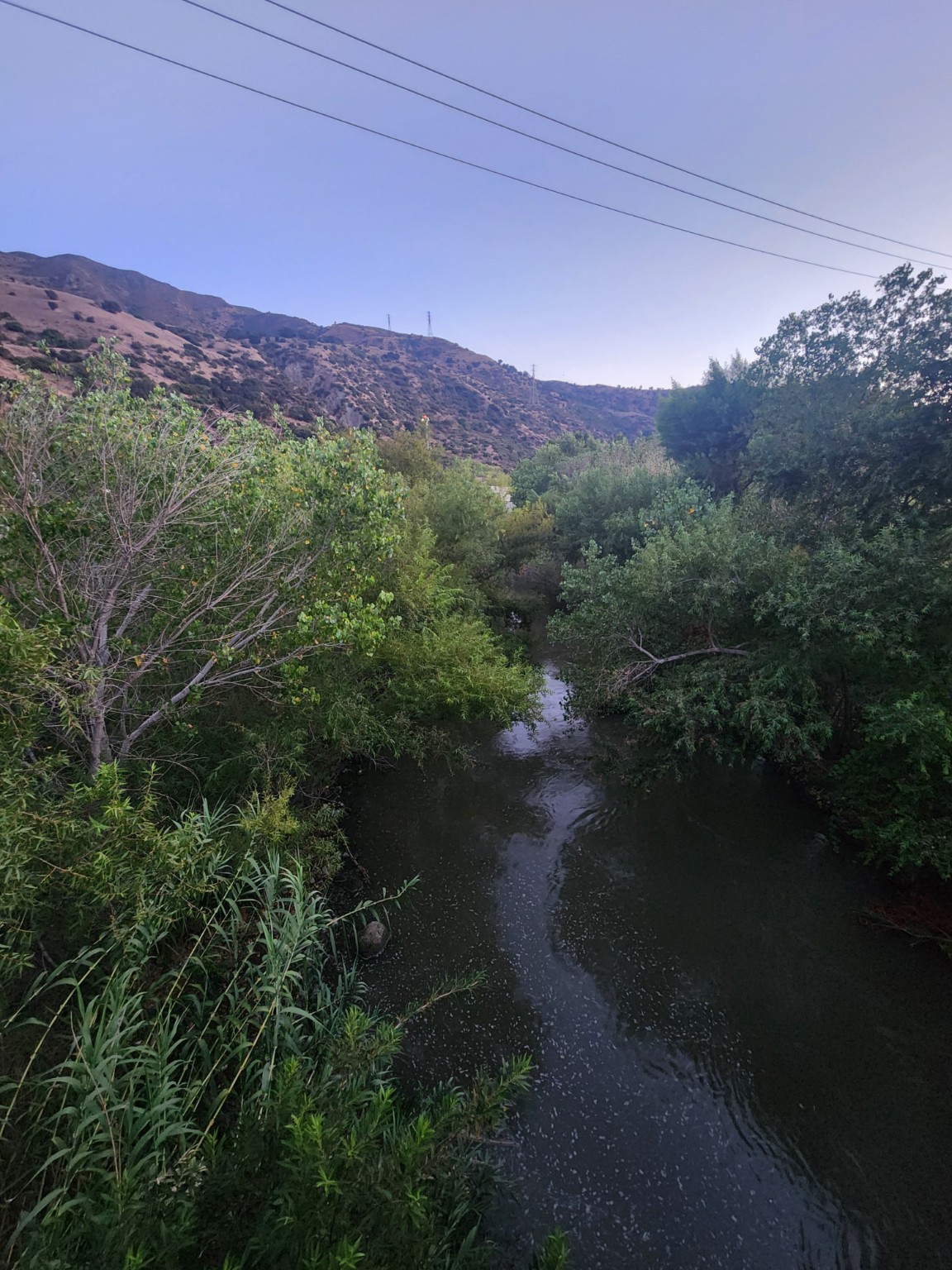
Evenings at the golf course offer a lively parade of visitors - golfers, of course, looking to play a few holes before the sun sets - but there are also hikers, bikers, and wanderers. Then there are dog walkers like us, fishermen angling for catfish, and at least one person rescuing orphaned golf balls from the weeds (apparently, selling secondhand golf balls is a lucrative side gig).
Whatever your preferred outdoor pursuit, if you've been at the golf course around dusk this week, you were likely treated to the wondrous spectacle of a massive bat colony fluttering and swarming through the sky.
I arrived at the golf course last evening with my Nikon strapped around my neck, which quickly caught the attention of Bill, one of the local dog dads. “Is that for the bats?” he asked.
“You betcha,” I replied.
Then my husband told Bill that we had figured out when and where to be if you wanted a front-row seat to the emergence. So we found ourselves with company as we waited for the bats that evening.
Our party arrived early, around 7:35, allowing us plenty of time to scope out the best vantage point from the bridge. The bats typically fly south, make their way down the narrow river passage, and climb a steep incline to rise above the dense canopies of cottonwoods and willows lining the river. Once they clear the trees, they make a 180-degree turn and head north over the golf course toward the Chino Hills.
We picked a spot near the center of the bridge with the best view downriver. I stepped onto the metal railing and hung my upper body over the bridge for a closer inspection of the soffit. The first thing I noticed was loud chittering and squeaking coming from underneath the bridge. The bats were clearly growing restless as their departure time approached.
Next came the smell. I can't say I've smelled bat guano before, but I have a strong suspicion that's what came wafting out from beneath the bridge. The scent was part earthy, part sweet-and-sour, and it came at us in waves as the breeze carried it upstream. The chittering and squeaking grew louder. I checked my phone. The screen read 7:41 p.m.
Almost showtime.
I glanced downstream at the river channel. It looked calm and serene, certainly not anticipating the whirlwind of activity it was about to experience. The relaxed atmosphere was short-lived. Suddenly, a large brown mass came hurtling toward us. It couldn't be a bat. It was too large, and it didn't have the herky-jerky motion of a flying rat on acid.
This thing was flying smoothly - and quickly - up the river channel. When it reached the bridge, it swooped up and over the concrete structure, then banked right. Just like that, it was out of sight. Farther downriver, I saw another dark-winged creature glide over the brown water and post up in the dense cottonwood canopy. It completely disappeared from view, obscured by the leaves, branches, and quickly approaching night.
And that's when I realized we weren't the only ones waiting for the bats.
I wasn't close enough to make a positive ID, but the birds appeared to be hawks. I was (mostly) kidding when I described bats as flying rats on acid, but I have to imagine that their speed, agility, and erratic flight patterns have evolved in response to being hunted by some of nature's most effective aerial predators. Raptors, in turn, have evolved their own remarkable speed and acceleration in pursuit of a meal. Such is time's eternal dance between predator and prey.
It was now 7:43 p.m., and the emergence was imminent. The clattering and squeaking of hundreds of bats had become so prominent that you didn't need to lean over the bridge to hear it above the nearby freeway.
At 7:44, we saw the first few bats take flight.
They scattered in multiple directions, swooping and circling in tight turns. Eventually they righted their course and flew downriver. Within seconds, the number of bats had risen exponentially. They were now streaming down the channel, forming a chiropteran river in the sky.
After about 30 seconds, I realized that I had woefully undercounted the colony. My initial estimate was 400 to 500 bats, but after witnessing the constant profusion escaping the roost, I revised my estimate to closer to 1,000 - possibly more.
As we stared, mesmerized by this magnificent sight, something snapped us out of our collective trance. The dark bird lying in wait in the cottonwoods suddenly sprang from its hiding place and dove toward the swelling mass of bats. Within a fraction of a second, it lifted itself over a tall sycamore and was gone. The strike was so blindingly fast that I could scarcely trust what I had seen.
Fortunately, I wasn't the only one who noticed it. My fellow witnesses on the bridge began our own version of excited clamoring and squawking.
“Did you see that?!”
“It was so fast!”
I looked at my phone, which was actively recording. “I think I got it,” I said.
“I think the hawk's the one who got it,” Bill quipped.
I suspected he might be right.
The bats continued in a steady stream for another 45 seconds before gradually dwindling to nothing. Ninety seconds of pure acrobatic excitement had just unfolded in front of us, and just like that - it was done.
Or was it?
As we turned to walk back to the truck, I heard the faint chittering and squeaking of bats again. We were still on the bridge, but closer to its support structure now. I stepped onto the guardrail, leaned over, and confirmed it: dozens, perhaps hundreds, of bats remained in the roost, possibly biding their time for a later departure or awaiting the return of their roostmates.
Driving back to the house, I could barely contain my excitement. I had inadvertently stumbled onto the location of what appeared to be a megacolony.
Once safely back in my own cave in Corona, I opened the video on my phone and began a thorough review of the footage. I had recorded the entire emergence, or so I thought. The bats were there - first a handful, then hundreds pouring down the river channel in a dark, flickering current. But when I played the video at full speed, the hawk was nowhere to be found. The strike had happened too quickly for the camera, just as it had happened too quickly for my eyes.
So I slowed everything down and began painstakingly reviewing the recording frame by frame.
At thirty-seven seconds, a blur separated itself from the cottonwood canopy. In one frame, it was hidden among the leaves. In the next, it was cutting through the river of bats. A fraction of a second later, it rose above the sycamore and disappeared.
The video could not tell me whether the hawk caught one. It could only confirm what all of us on the bridge had seen: the waiting bird had chosen its moment and struck.
All evening, I had thought we were waiting for the bats. But the bats had been waiting, too - for the light to fade, for the moment when leaving the safety of the bridge became less dangerous than remaining inside it. Beneath them, dozens more may have been biding their time. Above them, the hawks waited for hunger and opportunity to align.
Predator, prey, and observer: all watching the same darkening sky, all waiting for different reasons.
The hawks, it turns out, were doing the patient work long before we arrived.
And now, back in my own cave, I was doing it again, moving through the evening one frame at a time, waiting for the hawk to appear.
At thirty-seven seconds, it did.