
I've been visiting this little stretch of the Santa Ana River for the better part of a decade. I live in a small home with limited outdoor space, but I've always had big dogs—and big dogs need room to run, sniff, explore, and, to my chagrin, roll in mud and dead things.
The dogs who first accompanied me on these walks are no longer with us. Now I bring my new mutts, Lola and Honeybear, to investigate every accessible corner of the river.
Several years ago, during one of our evening strolls, I witnessed something marvelous—something I assumed would be a once-in-a-lifetime encounter.
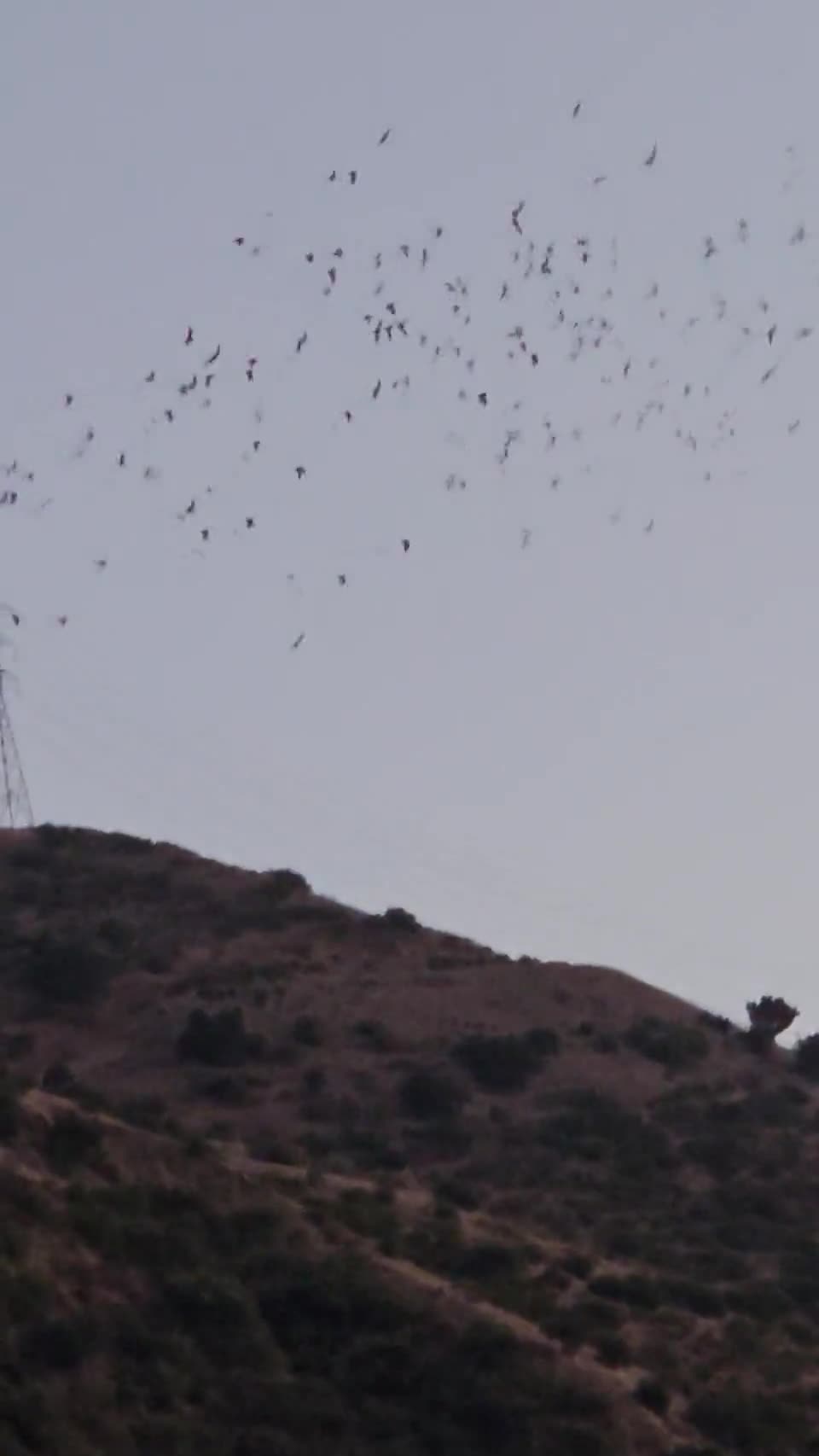
I was loading the dogs into the car in the twilight of dusk when I saw hundreds of dark figures fluttering, swooping, and swarming into the air. Silhouetted against a gray-and-mauve sky, the flowing black mass moved upward and northward.
I squinted at the figures and noticed the quick, irregular motion of their wings. These were not birds. They were bats—and not merely a few individuals, but an entire colony.
Just when I thought the moment had passed, another wave of jittering creatures rose into the sky. Then another. Over the next minute or two, approximately 400 or 500 bats—possibly more—emerged from somewhere nearby and streamed north toward the Chino Hills.
The experience left a profound impression on me. I had never knowingly seen a bat before, let alone an entire colony taking flight.
For years, most of my observations had focused on birds and butterflies: creatures of the day. Bats had largely escaped my everyday reality. They existed instead in childhood memories and the subconscious—otherworldly phantoms from cartoons, Halloween decorations, and perhaps one too many episodes of Scooby-Doo.
Witnessing that magnificent aerial display shifted my reality slightly. Bats were no longer symbols or shadows. They were animals living beside me in astonishing numbers.
And I had to wonder: Where had they come from?
A few bats tucked into a crevice might be easy to overlook. But a colony containing hundreds, perhaps even a thousand, would require a substantial hiding place.
I saw the bats at least once more that summer, moving north through the evening sky. Then years passed without another encounter.
Until recently.
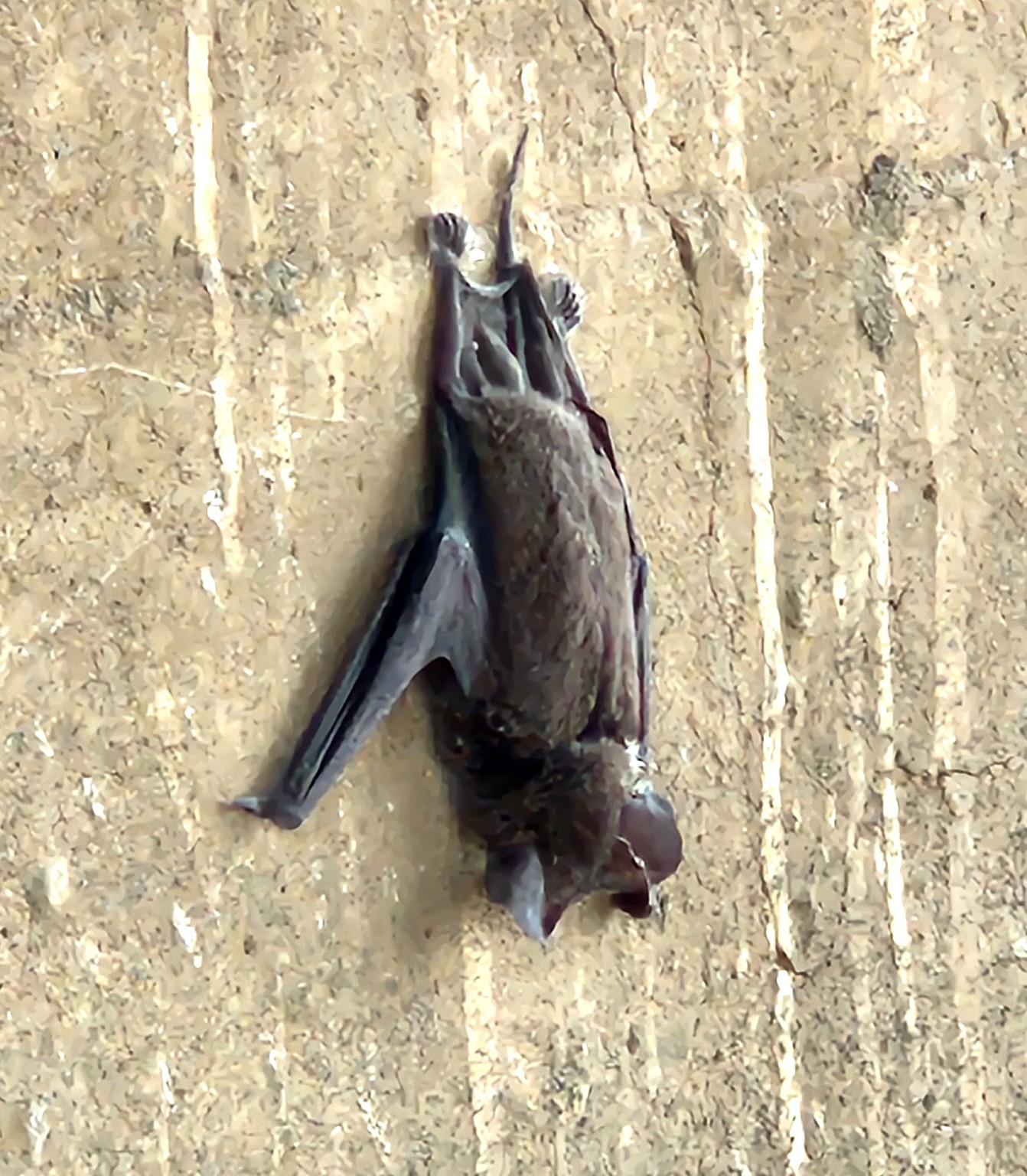
During our evening walks, we often follow the Santa Ana River and pass beneath the BNSF railroad bridge at Green River. One evening in May, I noticed what appeared to be a Mexican free-tailed bat clinging to a stuccoed support pillar beneath the bridge.
 © Lindsey Thome
It was completely still—almost too still—and unusually exposed. I wondered whether it was injured or ill, or simply sleeping very deeply.
Its body was uniformly brown, with folded wings and a face nearly indistinguishable from its neck. Its downward-facing position obscured its features even further. Because it remained motionless, I was able to take my first photographs of a bat and consult my twenty-first-century naturalist tools for a probable identification.
I didn't stay long. If the bat was sick or injured, I didn't want to disturb it.
But its presence left me with more questions. Why was it alone? Where was the rest of its colony? And why was it roosting there?
Fast-forward to this week.
It is mid-August. Temperatures have remained in the mid- to high nineties for weeks, and the sun has begun setting earlier than it did at the height of summer.
Once again, at the end of a riverside walk, I was loading the dogs into the car when I looked up and saw them.
Hundreds of dark figures swept into the sky, coalescing, diverging, and reforming as they traveled north over the golf course. I marveled at the aerial acrobatics as the bats swarmed, dispersed, and gathered again.
I stood there with my mouth agape, delighted to see the chiropteran spectacle return. I watched for so long that I nearly forgot to take a photograph.
Fortunately, I had the presence of mind to check the time.
It was 7:45 p.m., just a few minutes after sunset.
Now that I had an outlet for these observations, my next thought was immediate: Well, that's going in the blog.
The following evening, just as we were leaving, the bats appeared again. This time I had my camera ready. I took the photographs and video that appeared in my last post, Where the Wild Things Are.
The time was 7:43 p.m.
These bats were consistent.
I now knew when they would take flight, and I knew where they were going. But the location of their roost remained a mystery.
It had to be large enough to shelter hundreds of bats. From where I stood, they appeared to rise from the densely wooded riverbed and the thick cottonwood canopy. There was an underpass near the Santa Ana River Trail parking lot, along with several dark, concealed spaces beneath the trees.
The roost couldn't be far away. But I still couldn't see where the bats were coming from.
So I returned.
For five consecutive evenings, I waited near the river between 7:40 and 7:45. And every evening, without fail, the bats appeared at almost exactly 7:43.
On the fifth night, we finally saw where they were coming from.
The colony was not emerging from the freeway underpass or from some hidden cavern deep beneath the cottonwoods. The bats were pouring from beneath the entry bridge to Green River Golf Course—a familiar, ordinary structure I had crossed countless times without ever suspecting what it held.
For years, I had been walking over the answer.
Standing there at dusk, watching hundreds of bats stream out from beneath the bridge and rise above the trees, I realized that solving the mystery had required no extraordinary expedition. It required returning to the same place, at the same hour, with the same question held open night after night.
The wild world does not always hide itself somewhere distant or inaccessible. Sometimes it keeps an ordinary address, carries on just beneath our feet, and waits patiently for us to notice.
The patient work continues.